Jun 10, 2026
USCIS EAD Delays
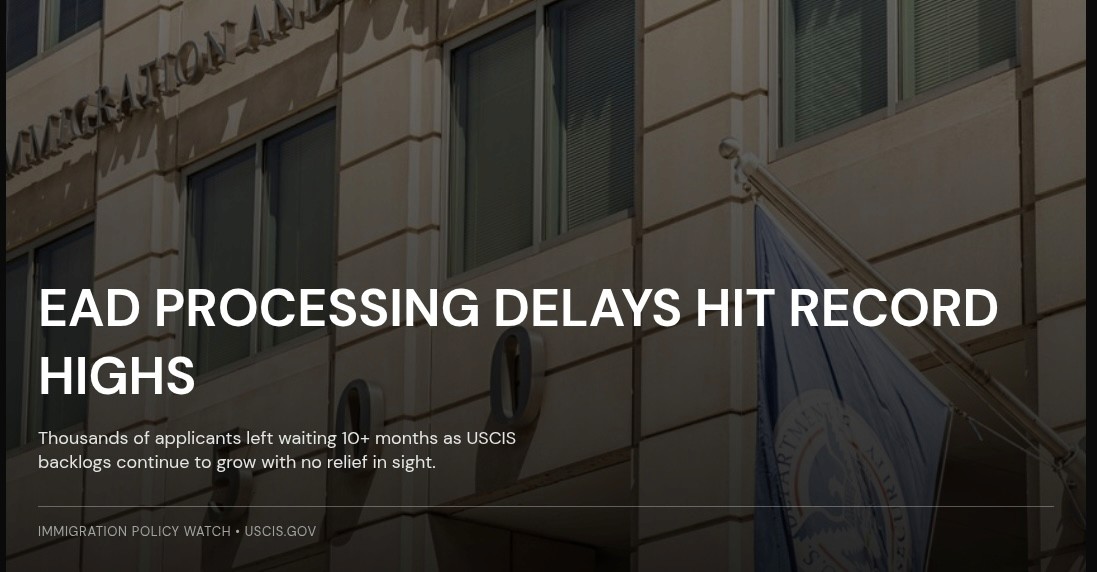
USCIS has significantly delayed the processing and issuance of Employment Authorization Documents (EADs). At the same time, the agency has largely discontinued the automatic extension of EAD validity for many renewal applicants. As a result, international graduates, other EAD applicants, and their employers are increasingly seeking guidance on options to expedite pending EAD applications
USCIS has significantly delayed the processing and issuance of Employment Authorization Documents (EADs). At the same time, the agency has largely discontinued the automatic extension of EAD validity for many renewal applicants. As a result, international graduates, other EAD applicants, and their employers are increasingly seeking guidance on options to expedite pending EAD applications.
USCIS reviews expedite requests on a case-by-case basis. An expedite request generally requires a separate submission supported by evidence demonstrating one or more of the following:
1. Severe Financial Loss
This is the most common basis for an expedite request. However, simply needing to work is not enough. USCIS requires documented evidence showing that significant financial harm will occur without prompt issuance of the EAD.
Examples include:
A job offer contingent upon receiving employment authorization
Placement on unpaid leave due to lack of work authorization
Inability to pay rent, utilities, medical expenses, or other essential obligations
Significant operational disruption to an employer
Supporting evidence may include employer letters, job offers, bank statements, eviction notices, medical bills, and a detailed comparison of monthly expenses versus lost income.
Importantly, USCIS generally will not grant an expedite request based on financial loss if the urgency resulted from the applicant’s failure to file on time or respond promptly to a Request for Evidence (RFE).
2. Emergencies or Urgent Humanitarian Situations
USCIS may expedite an application when there are compelling humanitarian concerns affecting the applicant or a close family member.
Examples include:
A serious medical condition that requires continued income or health coverage
Safety concerns or vulnerable living situations
Family emergencies requiring immediate financial support
Relevant evidence may include medical records, physician letters, affidavits, and other documentation demonstrating the urgency of the situation.
3. Nonprofit Organization Interested
Applicants employed by an IRS-designated nonprofit organization may qualify for expedited processing if their role directly advances the cultural or social interests of the United States and is both unique and time-sensitive.
The nonprofit organization must provide detailed evidence explaining:
Why the applicant’s work is critical to the organization
Why the role cannot be readily replaced
How delays would negatively impact an ongoing program or public-interest initiative
A standard employment verification letter is generally insufficient.
4. Government Interests
USCIS may expedite an application when a government agency identifies the case as involving urgent public-interest, public-safety, national-interest, or national-security concerns.
This category is relatively narrow and typically requires direct involvement or support from a government entity.
Additional Options for Pending EAD Applications
Applicants may also consider the following avenues:
Submitting a USCIS e-Request regarding a delayed application
Contacting their U.S. Congressional Representative’s Constituent Services office and requesting assistance with a USCIS case inquiry
————————————————————————————————————————
Contact Information
America Visa Advisory
Website: http://avamigration.co
Email: Elizabeth@avamigration.co
Please consult qualified immigration counsel regarding case-specific questions.
——————————————————————————————————————
Special Notice for Physicians Affected by the USCIS 39-Country Pause
USCIS continues to delay adjudication of some physician cases originating from countries previously subject to the USCIS 39-country processing pause, despite publicly announcing that physicians should be exempt from the pause.
If you are a medical doctor whose immigration case remains pending despite qualifying for the physician exemption, legal action may be available.
Our office can evaluate whether filing an Administrative Procedure Act (APA) lawsuit or a writ of mandamus in federal court may help compel adjudication of your case.
Law Office of Heidi J. Meyers
11 Broadway, Suite 925
New York, NY 10004
Email: heidimeyerslaw@hmeyers.com
Phone: (212) 791-4007 or (646) 508-5225
Default